
Dear allies,
I am pleased to share with you our second newsletter of the season, which contains both encouraging news and some less positive updates. You can count on us to highlight the good developments and to speak out, on your behalf, against what needs to be challenged. I am very proud of your citizens’ network for being present in the public sphere and for promoting the ideas that matter most to you!
Thank you for your continued support,
Jasmin Lemieux-Lefebvre
Coordinator
Living with Dignity Citizen Network
Spotlight on Palliative Care on “De garde 24/7” TV Show
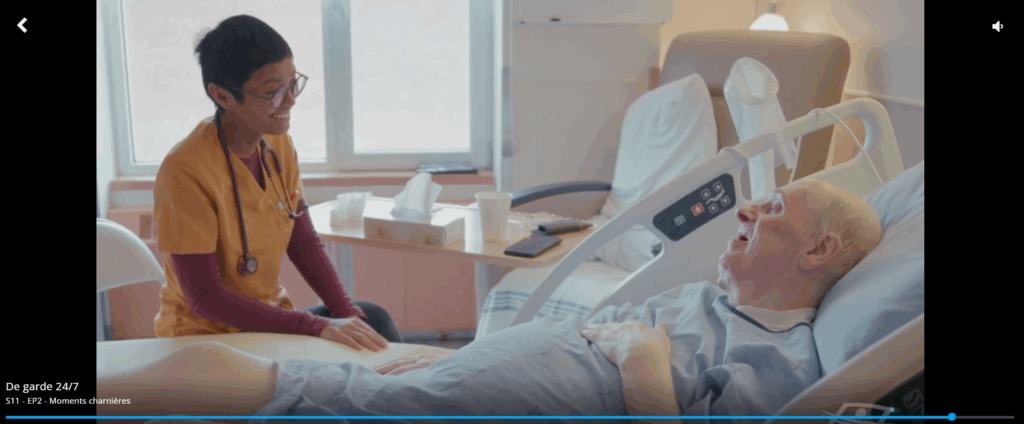
Did you
catch the episode of “De garde 24/7” last Thursday on Télé-Québec?
Dr. Olivia Nguyen is one of the physicians featured in the second episode of
this 11th season, and it’s hard to imagine a better showcase for palliative
care!
Two clips
are circulating on Facebook and Instagram:
- https://www.facebook.com/watch/?v=25278396885095379
- https://www.facebook.com/watch/?v=637120266121518
https://www.instagram.com/reel/DOYzaQADv-P
The full
episode is excellent (available on the Télé-Québec app or website: https://video.telequebec.tv/details/55017).
If you don’t have time to watch it all, here are the four segments where
palliative care is discussed:
- 05:13
to 08:42
- 16:14
to 19:41
- 26:01
to 28:20
- 41:18
to 44:10 (screenshot above)
According to a New Cardus Report: Medical Assistance in Dying Has a Disproportionate Impact on Canadians with Disabilities
A new report by Alexander Raikin “compares the
international evidence accepted in 2012 by the British Columbia Supreme Court
in Carter, which the Supreme Court of Canada subsequently upheld and affirmed,
with evidence from the nearly 10 years of MAiD in Canada:”
We invite
you to read the Cardus press
release and the 34-page
report entitled “In Contrast to Carter”.
Excerpt: When
assisted suicide (MAiD) was legalized in Canada, courts and legislators
expected that safeguards could be put in place to protect vulnerable groups,
such as persons with physical or mental disabilities, from heightened risk or
inordinate impact.
This
report examines whether these expectations have been borne out in reality,
using the available national and provincial data and peer-reviewed medical
studies.
This
report concludes that Canada’s legalization of assisted suicide has led to an
intensified risk of premature death for vulnerable groups, and that the
expected safeguards have failed to materialize.
From
2019 to 2023, at least 42 percent of all MAiD deaths were of persons who
required disability services, including over 1,017 persons who required but did
not receive these services. MAiD providers in Canada have euthanized disabled
persons who needed disability supports and were unable to access them.
Advance Requests for MAiD
Dr. Catherine Ferrier from Our Board Cited in the Montreal Gazette and the National Post
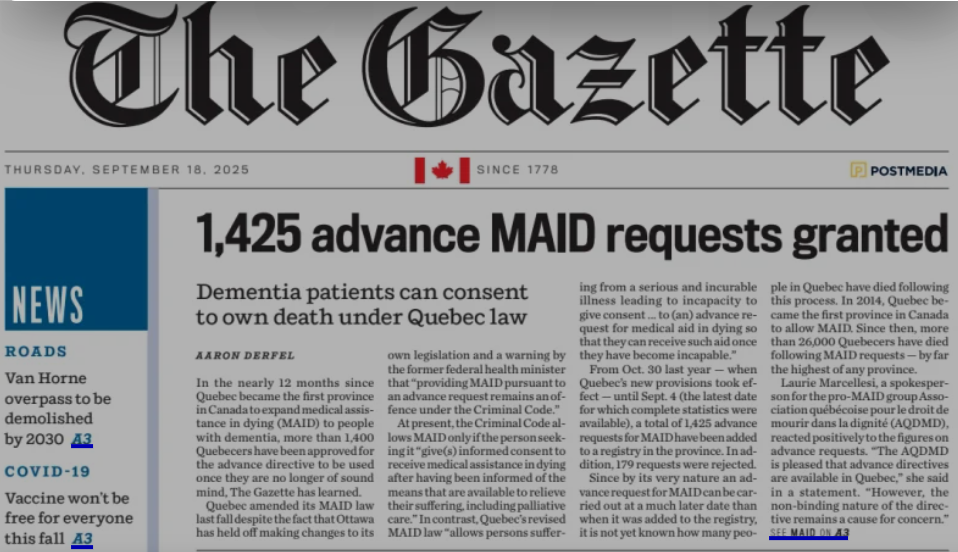
An article by journalist Aaron Derfel – featured on today’s front page of both the Montreal Gazette and the National Post –reports that “From Oct. 30 last year — when Quebec’s new provisions took effect — until Sept. 4 (the latest date for which complete statistics were available), a total of 1,425 advance requests for MAID have been added to the registry in the province. In addition, 179 requests were rejected.”
Excerpt :
Dr. Catherine Ferrier, a member of the board of directors of the (…) group Vivre dans la dignité, noted the number of advance requests registered is much lower than initial projections on the order of 10,000. She’s opposed to advance directives for people with dementia and to MAID in general, especially in the context of a health care system that does not have adequate resources. “I think that MAID by advance request is not really workable,” Ferrier said. “I don’t think you can have adequate consent. I think for the more than 1,400 people who have already requested it, I’m doubtful about whether they consented properly, because consenting to your own death is beyond what most people can conceive of when it’s not immediate.” Ferrier, who is assistant professor in the department of family medicine at McGill University, treats patients with dementia and their views on their quality of life can change over time. From her experience, many individuals adapt well to living with dementia, but if some had previously consented to an advance directive, they may not be in position to say they’ve changed their mind prior to MAID being administered.
Read more at:
https://www.montrealgazette.com/news/health/article1171462.html
Our Coordinator on the Télé Handicap YouTube Channel

We would like to thank the Quebec Cerebral Palsy Association for this 40-minute interview with their president, Joseph Khoury, and our coordinator Jasmin Lemieux-Lefebvre.
After discussing his personal and professional journey, Jasmin talks about his
role within our citizens’ network (9:46).
To Watch, Read, or Listen To
1) Some of Canada’s latest MAiD recipients:
An obese woman and a grieving widower
An article from the National Post and an open letter by Ramona Coelho, “Shouldn’t care come before MAiD?”, in National Newswatch.
2) “Savings” and Palliative Care – Dear Government, What If It Were You?
The testimony of Martine Delvaux, to read in La Presse.
3) “Another article that romanticizes euthanasia for people with disabilities. A death of despair is portrayed as inevitable, a heroic act to be celebrated, an emotional soap opera episode.”
Jonathan Marchand’s response to the
La Presse article Sébastien voulait partir en faisant le bien can be read on his LinkedIn or Facebook page.
4) Author Robert Munsch is approved for MAID, but his daughter clarifies he’s ‘not dying’
CBC Story
Will You Love Me Forever?
A beautiful response from Amanda Achtman in Public Discourse
5) The Link Between Music Therapy and Alzheimer’s Explored This Fall on TV
An article from the daily newspaper Le Devoir.
Two television projects from the fall season are explored:
- Tous en chœur, starting October 8 on AMI-télé (a project by Gregory Charles, which we mentioned in our first newsletter of the season)
- J’ai souvenir encore, December 2 on ICI Radio-Canada Télé
Trailer link for this documentary project by France Beaudoin.
SEP
2025