
Dear allies,
A short introduction to this edition, in which
we look back on recent news, including a powerful column by Mylène Moisan in Le
Soleil and the troubling case of Siska De Ruysscher, a 25-year-old Belgian
woman whose story directly relates to Canada as Parliament prepares to debate
Bill C-218 and MAiD for mental illness.
We’re also sharing the latest updates on the public consultation surrounding
Quebec’s draft constitution—and the place that end-of-life issues may occupy
within it. Of course, we plan to take part in the consultation on your behalf!
Wishing you an excellent end of October,
Jasmin Lemieux-Lefebvre
Coordinator
Living with Dignity Citizen Network
Update: We
have learned of the passing of Archbishop Emeritus Bertrand Blanchet of
Rimouski, author of La bioéthique, repères d’humanité and biologist by
training. Our Citizen Network honours his many contributions over the years in
defence of human dignity. Our condolences to his family and loved ones.
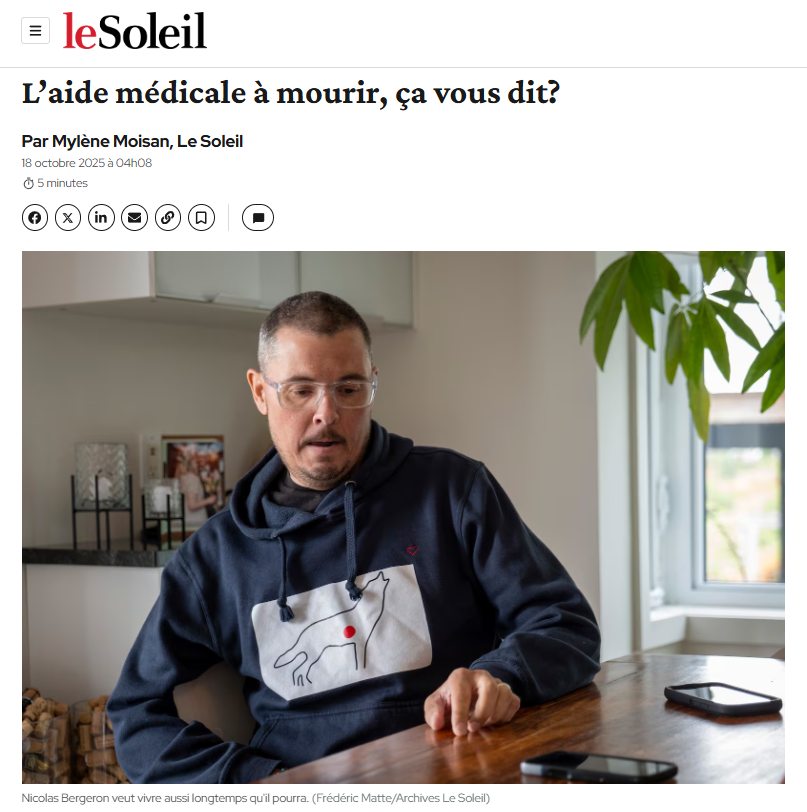
“Medical Assistance in Dying — Does That Speak to You?”
That’s the title of Mylène Moisan’s column published
in Le Soleil on October 18th (L’aide médicale à mourir, ça vous
dit?).
Excerpt: But the social worker came to offer
him something entirely different—his end-of-life options. One in particular:
medical assistance in dying. (…) The idea was, “If you decide to let go and
sign for MAiD, you’ll have a much better quality of life.”
Here’s the comment written by our coordinator
and published under the article (our translation):
“Hats off to Nicolas and Noémie for filing a
complaint. Such behaviour is unacceptable—and, unfortunately, not exceptional.
Let’s remember that in December 2015, when Quebec’s Act respecting
end-of-life care came into force, best practice required waiting until the
patient mentioned MAiD before anyone raised the topic. Sadly, that’s no longer
the case ten years later. Yes, I don’t doubt that most mentions of MAiD by
health professionals are meant to inform, but cases like this social worker’s
expose a real problem that also affects people with disabilities.
This column appeared four days after testimony by Krista Carr of Inclusion
Canada before the House of Commons Standing Committee on Finance (FINA). Here’s
what she said: ‘Persons with disabilities now very often fear going into the
health-care system for ordinary health issues, because they are sometimes
offered MAiD as a solution to what is perceived as intolerable suffering.’
Yes, that’s where we seem to be now.
And we should fix it.”
P.S. It’s still possible to support Nicolas and
Noémie, who have now reached 65 % of their goal on GoFundMe: “Help Nicolas
Bergeron, 45, incurable cancer.”
You can
hear Krista Carr’s remarks at 16:45:15 here:
https://parlvu.parl.gc.ca/Harmony/fr/PowerBrowser/PowerBrowserV2?fk=13158109
or through this viral post by MP Garnett Genuis:
https://www.facebook.com/reel/1380014227072784
Two Days Later: Another Reaction in Le
Soleil
On October 20th, Le
Soleil published an open letter by Louis
Cummins, philosopher and retired teacher:
Excerpt: Nicolas’s story is a horror story.
After being denied the attention and care he had a right to expect, he was
persistently shown another door—the one leading to services that would dispatch
him out of this world.
In New Zealand, health professionals are not
allowed to suggest assisted dying to their patients. It’s up to the individual
to raise the issue with their care team. That is an important safeguard in
their law—one that should inspire us.
MAiD and Mental Illness — Siska’s Story Should Make Canada Think
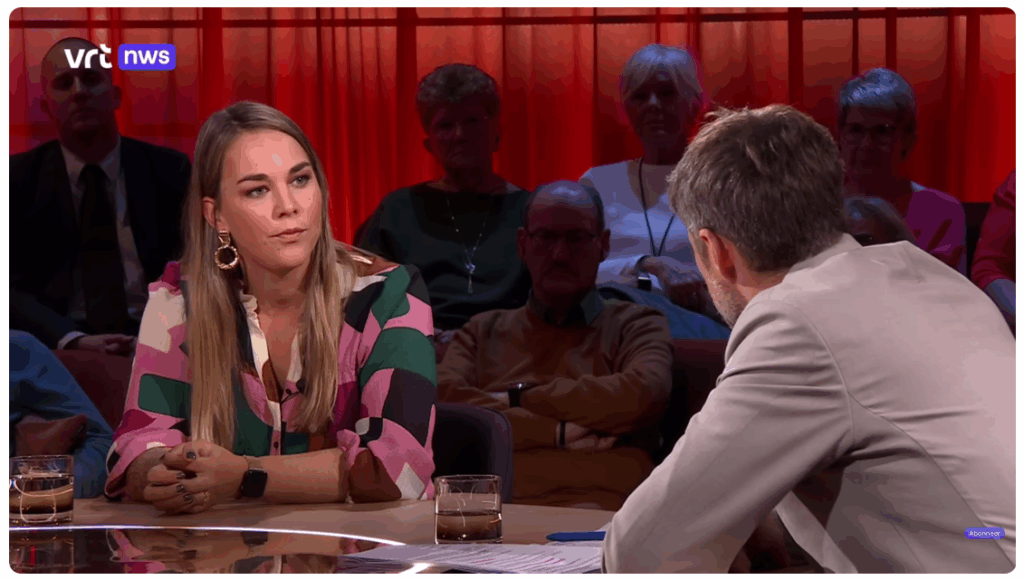
Siska De Ruysscher, a 25-year-old Belgian
woman, has been granted approval for euthanasia due to psychological suffering.
On October 3rd, she posted a long open letter on Instagram that has sparked
debate in the Flemish media. Supporters argue that her decision reflects her
right to autonomy and that Belgian law imposes strict safeguards (multiple
medical opinions, lengthy procedures). Opponents counter that at age 25,
incurability is difficult to assert—and worry that euthanasia risks becoming a
response to gaps in care rather than to illness itself.
As of now, Siska’s open letter is available
only in Dutch on her Instagram page. We have translated it into English and
French on our blog, with additional content from Flemish media:
https://vivredignite.org/siska-story.
Siska’s
story should prompt reflection among Canadian lawmakers as debate resumes this
fall on Bill C-218, a private member’s bill (introduced in a non-partisan
spirit by Conservative MP Tamara Jansen) that would amend the Criminal Code
to specify that a mental disorder is not a grievous and irremediable medical
condition for which a person may receive medical assistance in dying.
This is an
important initiative to block the scheduled expansion of Canada’s MAiD law on
March 17, 2027, when MAiD would otherwise become available if a person’s sole
underlying condition is a mental illness.
Do we
really want a young woman like Siska to be eligible for MAiD in Canada?
Quebec’s Draft Constitution: Consultation and Open Letter
Should a future Quebec constitution address the issue of the “right to die with dignity”? While government communications mention only the right to receive “medical assistance in dying,” the draft bill instead refers to the right to receive “end-of-life care”—a broader term that includes palliative care, palliative sedation, and MAiD.
Contrary to some early media reports, we now have more time than expected to prepare briefs responding to the draft constitution—until November 24th instead of November 12th. Public hearings will begin on December 4th (instead of November 25th).
To read the National Assembly’s press release and find out how to participate:
https://www.assnat.qc.ca/fr/actualites-salle-presse/communiques/CommuniquePresse-7511.html
Public commentary is also welcome, such as Monique Khouzam Gendron’s letter “Assisted dying—How far will we go?”,
published by Le Soleil and the Coops de l’info on October 14th
(also available on her Facebook page).
Here is our coordinator’s comment, also posted under her open letter:
“Under the current proposal (Bill No. 1, Constitutional Act, 2025 on Quebec), the Quebec Charter of Human Rights and Freedoms would be amended to add the following article:
‘39.2 Every person whose condition so requires has the right to receive end-of-life care, subject to the specific requirements set out in the Act respecting end-of-life care (chapter S-32.0001).’
Yet, all of the government’s communication materials about the draft constitution (visuals, press release, news conference, and interviews) refer solely to the ‘right to die with dignity’ and to ‘receiving medical assistance in dying’.
This approach has led most Quebecers to now associate MAiD with the best—or only—way to ‘die with dignity’ (69 % of people aged 55 and older, according to a Léger poll on perceptions of end-of-life services, commissioned by the PalliAmi Foundation last March).
Palliative care is at the heart of the Act respecting end-of-life care.
I invite Minister Jolin-Barrette and members of the National Assembly not to forget that as they move forward with Quebec’s constitutional project.”
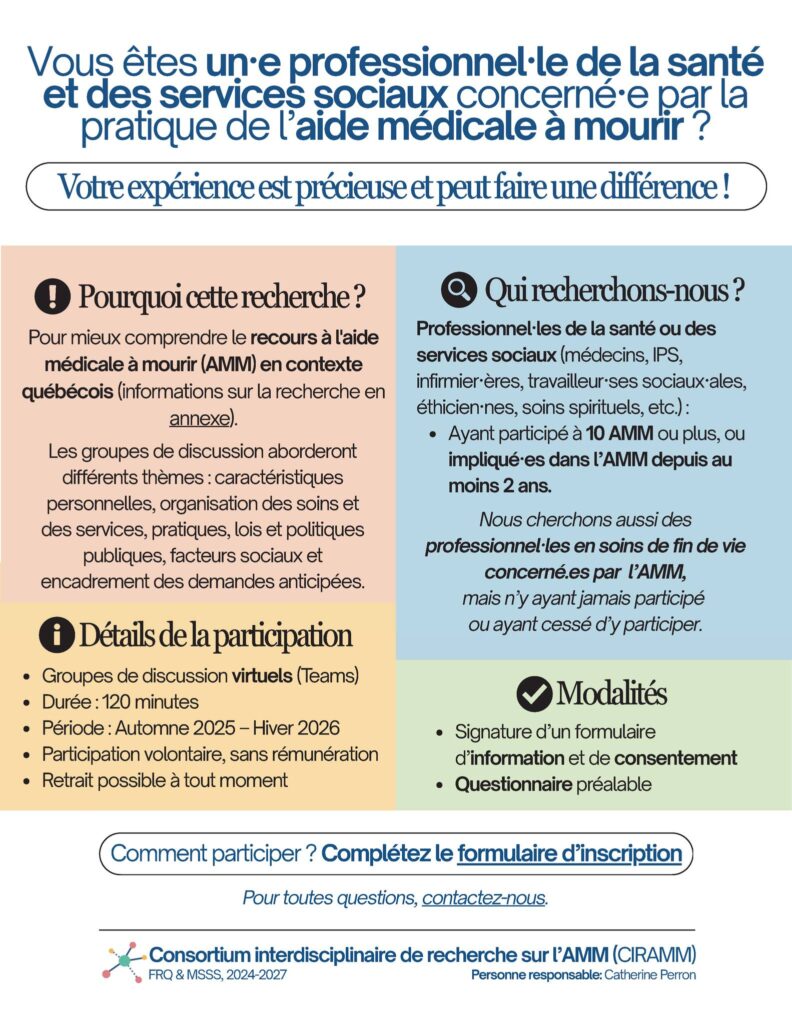
CIRAMM: Focus Groups with Health Professionals
The Interdisciplinary Research Consortium on Medical Assistance in Dying (CIRAMM) is launching focus groups with health-care professionals from Quebec —including those working in palliative care (medicine, nursing, social work, ethics, spiritual care, etc.)—who are affected by MAiD but have never participated or have since stopped doing so.
We encourage you to take part in this study, led by Catherine Perron. To register, please fill out this form: https://bit.ly/CIRAMM.
Official communication in French below.
OCT
2025