
Dear allies,
Last Monday, we sent a brief on your behalf to
the Commission on Institutions in response to Bill 1, the 2025
Constitutional Act on Québec. We cannot wait to share it with you! The public hearings will begin on
December 4th, and we hope to take part in them. If adopted, Québec would become
the only jurisdiction in the world to enshrine in a foundational text the
“right to die with dignity” and the right “to receive medical assistance in
dying.”
We will also soon be launching our campaign
marking the 10th anniversary of the Act Respecting End-of-Life Care
(December 10, 2015).
We are also
closely monitoring the impact of Bill 2 on palliative care teams (kudos to Dr. Olivia
Nguyen for her interview in the “To watch, read or listen” section).
A demanding
month of December lies ahead.
Thank you
for your ongoing support,
Jasmin
Lemieux-Lefebvre
Coordinator
Living with Dignity citizen network
Death of Mr. Normand Meunier - Release of the Public Inquiry Report
Important news released yesterday: “The Coroner’s Office announced
the release of the public inquiry report by Coroner Dave Kimpton regarding the
death of Mr. Normand Meunier, which occurred on March 29, 2024. Mr. Meunier
received medical assistance in dying following medical complications from
infected pressure ulcers, in the context of sensory loss and significant
clinical vulnerability.”
We commend the Coroner’s 31 recommendations and the work of MÉMO-Québec (Moelle
épinière et motricité Québec) on this file.
The entire
report is worth reading, but we wish to draw your attention to two excerpts
from the summary of MÉMO-Québec’s submissions (page 29 of the report):
“Mr.
Meunier’s situation is not an isolated case. Since 2023, MÉMO-Québec has been
keeping a registry of members living with persistent stage 3 or 4 pressure
ulcers. Twenty-five members have written to provincial MNAs and ministers to
report the shortcomings observed in prevention and care. Even more concerning is
that at least twelve members who requested MAiD were living in situations
directly related to lack of care, primarily linked to pressure-ulcer problems.
The
organization denounces a dangerous gap between the spirit of the MAiD law and
requests arising from lack of care, lamenting society’s failure to ensure a
medical assistance ‘to live.’”
Update: MÉMO-Qc
will launch a class action to prevent further tragedies.
Online Memorial in Honour of
Dr. Balfour Mount
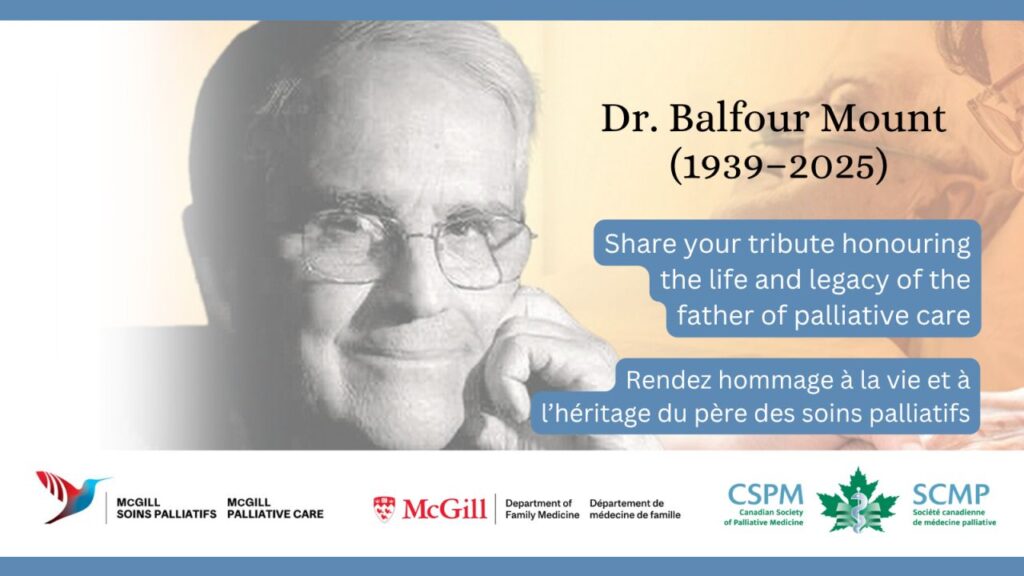
An
invitation for December 4th, from 11:00 a.m. to 12:30 p.m. (EST). To register on Zoom.
Description: “Moderated by Dr Justin Sanders, Director of Palliative Care McGill, McGill
University, and Dr John Scott, President, Canadian Society of Palliative
Medicine, with tributes from many international colleagues and friends
including renowned figures in palliative care: Ira Byock, Kathy Foley, Richard
Cruess, Sue Britton, Johanne de Montigny, and many others. To read the tributes already
available online.
Documentary Theatre on Medical Assistance in Dying
Club sandwich mayonnaise – opening April 2026
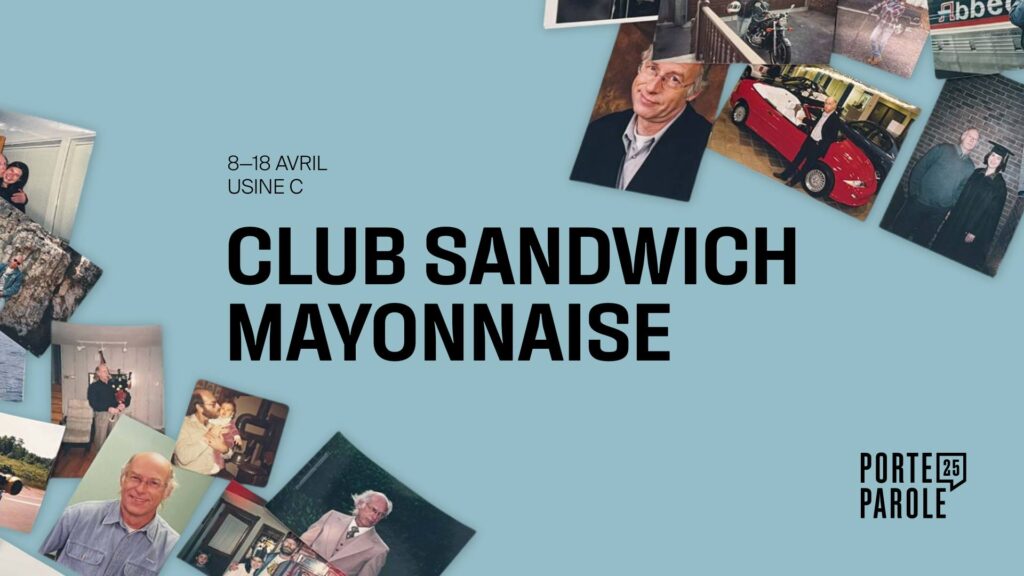
In June 2024, we took part in an interview to help prepare this Porte Parole theatre production exploring MAiD from a documentary standpoint. Like you, we will discover it on April 8th in Montréal, and we hope to participate actively in the dialogues and debates it may generate. If you would also like to attend, tickets are now available for the April 8th to18th, 2026 performances at Usine C: https://bit.ly/csm-billetterie. For groups of 10 people or more, get a 25% discount by booking through Adèle Benoit at abenoit@porteparole.org.
Synopsis: In Québec, choosing the date and time of one’s death has become an increasingly common reality: medical assistance in dying already accounts for more than 7% of annual deaths. But are we collectively equipped to navigate this new way of dying? On October 5, 2021, Manuelle Légaré accompanied her father, comedian Pierre Légaré, in his final days—he had chosen medical assistance in dying. With Club sandwich mayonnaise, she takes to the stage for the first time, seeking space to understand what she lived through, to ask the questions she did not have time to ask then. Blending personal storytelling and social inquiry, humour and existential vertigo, the play explores the human and ethical dimensions of this profound shift in our relationship to death.
Discussions with the artists and guests after each performance!
To Watch, Read or Listen
1) “A fast track-driven approach goes against practices that take
time”: palliative-care physicians fear the impact of Bill 2
Interview from November 15th with Dr. Olivia Nguyen in the Journal de Montréal
and TVA Nouvelles
(in French).
2) Lack of reliable data on palliative care in Québec: a worrisome
finding
Reaction from the Québec Palliative
Care Association to the 2024–2025 annual activity report of the Commission on
End-of-Life Care,
also published in the Coop de l’info newspapers (in French).
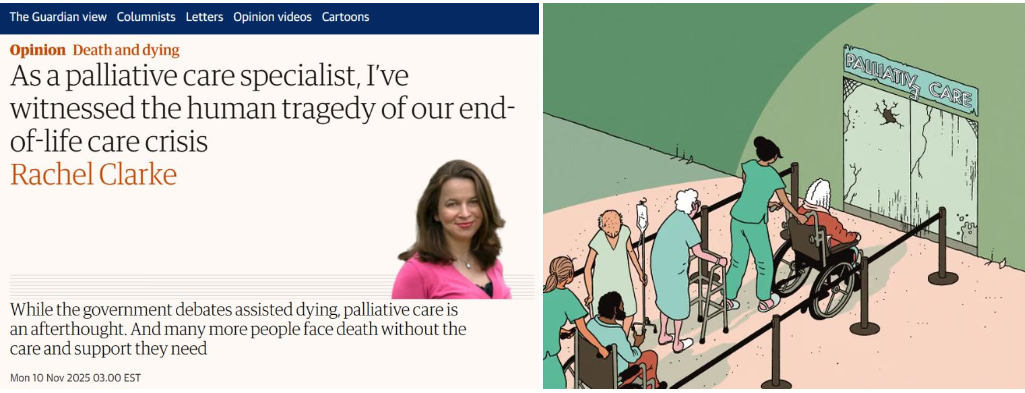
3) “As a palliative-care specialist, I have witnessed the human
tragedy of our end-of-life care crisis”
An op-ed by Dr. Rachel Clarke, palliative-care specialist with the UK’s
National Health Service (NHS), published on November 10th in The Guardian. We translated it into French for
you on our LinkedIn page (accessible without an account).
4) Compassion or Abandonment? Canada’s Growing Courtship with Assisted Death Expansion
The latest webinar from the Doctors Say No association, presented by Dr. K. Sonu Gaind, professor at the University of Toronto and Chief of Psychiatry at Sunnybrook Health Sciences Centre in Toronto.
5) Tous en chœur — the series featuring individuals with Alzheimer’s disease in a choir guided by Gregory Charles (the finale aired in French Wednesday evening on AMI-tv; all eight episodes are now available on amiplus.ca)
6) Documentary “J’ai souvenir encore” — France Beaudoin embarks on a personal journey to understand the power of music on Alzheimer’s disease.
Airing in French December 2 at 8 p.m. on ICI Radio-Canada Télé or on demand on TOU.TV.
7) “Why Didn’t I Say Something?” A five-minute video produced by the Dying to Meet You project, in which a young Canadian recounts “his experience of losing both of his grandmothers to euthanasia.”
NOV
2025