
Happy New
Year 2026!
We are
starting the year with encouraging news. First, a majority of French senators
rejected the article on “assisted dying” which, according to French newspaper Le
Monde, set out “the conditions required to access a system of assisted
suicide or euthanasia.” As you will see, however, this rejection is not the end
of the matter.
In this
first newsletter of the year, we will also highlight a position statement from
the International Association for Suicide Prevention that largely went
unnoticed at the end of 2025.
Major
challenges lie ahead in the coming year. Thank you for your continued and
faithful support.
Jasmin
Lemieux-Lefebvre
Coordinator
Living with Dignity citizen network
The French Senate rejects a key article creating a “right to assisted dying”
This is how Le Monde reported the news:
“Senators opposed, on Wednesday, January 21, the creation of any form of assisted dying during the end-of-life debates, with the chamber, dominated by the right, shelving this major societal reform, which is nonetheless expected to return soon to the National Assembly.
Highly chaotic and confused, the debates were cut short with the rejection of a first article setting out the conditions required to access assisted suicide or euthanasia, which was struck down by 144 votes to 123.”
Some opposed the measure to block the opening of assisted dying altogether, while others voted against it because the Senate’s revised version was considered too restrictive by certain political groups.
Earlier this week, we published in French a blog post to clarify the issues at stake in this debate. In it you will find:
- an analysis by the French Society for Palliative Care and Support;
- the Journal du Dimanche article, Legalizing euthanasia: what the Quebec example teaches us, including testimonies from Nicolas Bergeron and Noémie Cloutier (a reminder of their GoFundMe), as well as Jonathan Marchand;
- Mediapart’s investigative report on MAiD in Quebec;
- links to follow the Senate’s proceedings and the initiatives of the groups Les Éligibles et leurs Aidants and Fondapol, along with the open letter signed by
author Michel Houellebecq, Emmanuel Hirsch, and Laurent Frémont.
https://vivredignite.org/assistance-medicale-a-mourir-le-debat-francais-reprend
We are also sharing today a powerful short comic by Mathilde François, posted in French on January 20th on her Facebook page: “Euthanasia: social progress for whom?”;
Original version published on her blog last May:
https://lavieacroquer.wordpress.com/2025/05/22/inapte-episode-18-euthanasie-un-progres-social-pour-qui

Statement from the International Association for Suicide Prevention on MAiD for mental illness
On December 1st, the International Association for Suicide Prevention released an important document that went largely unnoticed in Canada: IASP Position Statement on Assisted Suicide and Euthanasia.
As Canada still plans to expand eligibility in March 2027 to allow MAiD where mental illness is the sole underlying medical condition, this document is essential reading. Its conclusion states:
IASP is concerned that because of the inability, documented in current research, to predict which persons with a mental illness have a poor or hopeless prognosis, and which will substantially improve, with or without treatment, we should not allow access to EaAS for persons whose suffering is solely associated with a
mental illness.
National Suicide Prevention Week is fast approaching (February 1st to 7th, 2026). We encourage you to make use of the many resources offered in English and French by the Quebec Association for Suicide Prevention under the theme “Land a hand. foster hope.”
https://daretotalkaboutsuicide.com/suicide-prevention-week
Petition: Universal access to home support services with no additional fees
As proud
signatories to this collective statement on the CAQ’s new home-support policy,
we invite you to sign this petition calling for universal access to home
support services without additional fees.
We commend
the leadership of Ariane Carpentier, community organizer at the
Pointe-Saint-Charles Community Clinic, who initiated this effort.
Sign the
petition (in French):
https://www.assnat.qc.ca/fr/exprimez-votre-opinion/petition/Petition-11793/index.html
Worth watching, reading, or listening to
– QUB Radio: Quebec, world champion
of Medical Assistance in Dying — “It doesn’t worry me, it actually reassures
me.” A surprising analysis in French from former Health Minister Gaétan
Barrette, now a Quebecor media commentator.
– CBC : Families
want Canadian provinces to end MAID opt-out policy for faith-based hospitals. This case could influence the
evolution of the file in which the
Archbishop of Montreal is challenging part of Quebec’s MAiD law, which
compels Maison St-Raphaël, a former church converted into a palliative care
home, to provide MAiD.
– Column by
Bert Keizer, Dutch physician and euthanasia provider: Strangely confusing,
how often Canadian doctors perform euthanasia.
English
excerpts available on Trudo Lemmens’ LinkedIn page.
– La Voix de
l’Est: Ten
years after its introduction, has medical assistance in dying truly been
integrated? Interviews in French with staff from the Au Diapason
palliative care home and the CIUSSS de l’Estrie. According to Dr. Alexandra
Cayer of the CIUSSS, “most physicians or nurse practitioners who refuse to
provide MAiD do so because of lack of availability, not because they oppose
this type of care.”
While a majority of physicians in Quebec support offering MAiD, the fact that
fewer than 10% administered it in 2024–2025 is not primarily due to
availability. A 2019 study
by Marie-Ève Bouthillier and Lucie Opatrny found that “The reason most
often cited is not based on moral and religious grounds. Rather, the emotional
burden related to this act and the fear of psychological repercussions were the
most expressed motivations for not participating in medical aid in dying.”
Slightly under 3% of MAiD cases in 2024–2025 were carried out by nurse practitioners.
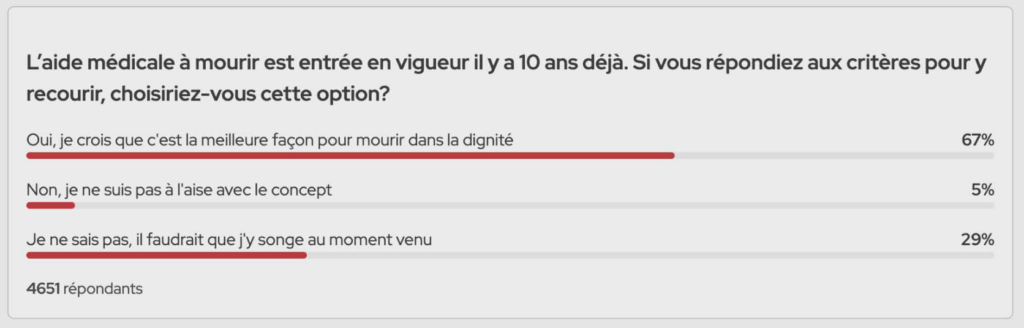
A poll
accompanied the article, asking:
If you met the criteria for MAiD, would you choose this option?
The
results:
Yes, I believe it is the best way to die with dignity — 66%
No, I am not comfortable with the concept — 5%
I don’t know, I would need to think about it when the time comes — 29%
These
responses remind us why we must continue our work to demonstrate that
palliative care enables people to die with dignity, without a shadow of a
doubt.
JAN
2026