
Dear allies,
The bills on assisted dying and palliative care
return to the French National Assembly on Monday, February 16th, with a solemn
vote expected on the 24th. Alongside these debates, we are sharing with you today
statements from the French National Medical Council, the French National
Nursing Council, and the International Association for Hospice and Palliative
Care.
This newsletter also presents the new document
proposed by the Catholic Bishops of Québec on “pastoral support for people at
the end of life.” As a citizen network, we have often hesitated to share
statements from religious groups so as not to cloud the issues. We now believe
that our non-political and non-religious approach should never prevent us from
highlighting voices from civil society that allow for constructive dialogue on
end-of-life issues.
We welcome your feedback on this choice. We
consider it consistent with our desire to engage as widely as possible on
issues that matter both to you and to us.
Happy
Carnival to everyone celebrating in Québec city (the best!) or elsewhere,
Jasmin
Lemieux-Lefebvre
Coordinator
Living with Dignity
Debates in France: Statements from the French National Medical Council and the International Association for Hospice and Palliative Care
A few days before the resumption of discussions
on the bill regarding the right to assisted dying and the bill aimed at guaranteeing equal access for all
to support and palliative care, we would like to share two statements published this week that
contrast with the Québec landscape, where medical assistance in dying is an
integral part of the continuum of care.
1) International Association for Hospice and
Palliative Care (IAHPC)
Excerpt (full letter on the LinkedIn page of
Dr. Claire Fourcade,
Head of Advocacy at the French Society for Hospice and Palliative Care):
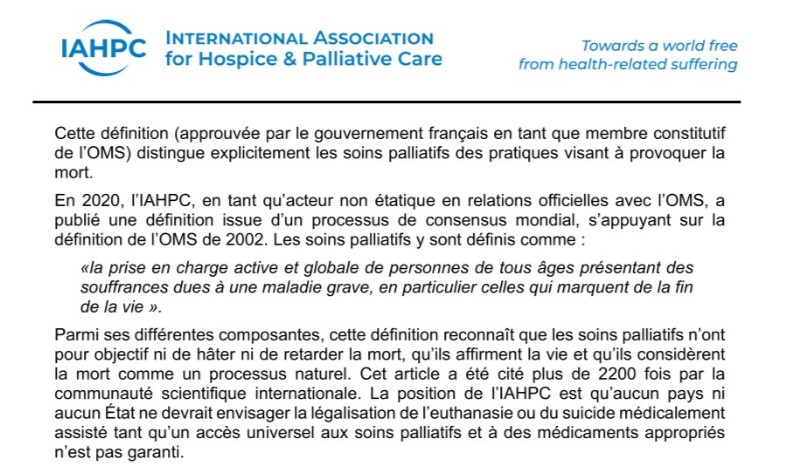
In 2020, the International Association for
Hospice and Palliative Care (IAHPC), as a non-state actor in official relations
with the WHO, published a definition based on a global consensus process,
drawing on the WHO’s 2002 definition. Palliative care is defined as:
“the active and comprehensive care of people of
all ages experiencing suffering due to a serious illness, particularly those
approaching the end of life.”
Among its various components, this definition
acknowledges that palliative care aims neither to hasten nor to delay death,
that it affirms life, and that it considers death a natural process. This
article has been cited more than 2,200 times by the international scientific
community. The IAHPC’s position is that no country or state should consider
legalizing euthanasia or physician-assisted suicide until universal access to
palliative care and appropriate medications is guaranteed.
2) French National Medical and Nursing Councils
Excerpt (full text):
(They) strongly reaffirm that the absolute
priority must be the implementation of a genuine national palliative care
policy. This policy should ensure the deployment of palliative care teams in
all departments, as well as the creation and ramping up of hospice and
palliative care facilities adapted to the needs of patients and their families.
Physicians and nurses must “accompany the dying person until their last
moments, ensuring, through appropriate care and measures, the quality of a life
that is ending, safeguarding the dignity of the patient, and comforting their
loved ones.” They cannot deliberately cause death.
“Compassionate Support,” the Cornerstone of a New Document by Québec’s Catholic Bishops
On the occasion of World Day of the Sick
(February 11th), the Assemblée des évêques catholiques du Québec (AECQ) / Assembly
of Catholic Bishops of Québec released a document entitled Pastoral
Support Guidelines for People at the End of Life. We invite you to consult
this 35-page document, which reflects the approach of a civil society actor
whose voice continues to have a significant impact within Québec society.
The motivations for promoting palliative care
and respectfully opposing medical assistance in dying and overtreatment can be
varied. We commend the cornerstone idea developed in this tool: compassionate
support.
From a practical perspective, we are
particularly interested in the questions raised on page 7 of the document. Many
passages address anyone questioning a loved one’s end-of-life choices. Examples
include:
- Should
I insist on clarifying the person’s consciousness so that they might
reconsider their decision?
- Or
should I rather avoid disturbing their peace so they can “depart
peacefully”?
- What
paths can be traced between these two seemingly diametrically opposed
options?
We partly answer these questions in our online
tool: www.aidinliving.org.
Regardless of your affiliation or
non-affiliation with any religious tradition, the bishops’ document deserves
your attention.
Invitation: Research on Knowledge and Perceptions of Advance Requests for Medical Assistance in Dying
Here is a research project approved by the
Ethics Committee at Université Laval that we invite you to participate in:
As part of an exploratory research project led
by Anne-Marie Savard, full professor at Université Laval, we wish to interview
people aged 65 and over, as well as caregivers, about their knowledge and
perceptions of advance requests for medical assistance in dying (AR-MAD). The
main objective is to document and better understand current practices regarding
advance requests for medical assistance in dying by consulting all involved
parties, including people aged 65+ and caregivers.
The interview lasts about 45 minutes and will
be conducted online via Microsoft Teams. It will be audio-recorded with your
consent.
To participate, please email: ariane.plaisance@fsi.ulaval.ca.
To See, Read, or Hear
1) The
Québec Alliance of Hospice Homes now benefits from the expertise of a new
Executive Director, Marie-Julie Tschiember. Congratulations!
(Press release)
2) MAiD has become routine. Would it be so if
palliative care was more widely available?
Article on Policy Options. Drs. Leonie Herx, Rebecca Vachon,
and Peter Tanuseputro, specialists in public health and palliative medicine
commissioned by Cardus, analyze six years of Health Canada annual
reports on MAiD, raising questions about the real scope of “informed choice.”
3) MAiD for young Kiano Vafaeian in B.C.
after being repeatedly rejected in Ontario
Global News report (2-min video on YouTube)
Kiano
Vafaeian was 26 years old when he received medical assistance in dying (MAiD)
on December 30th. His family stated that he lived with type 1 diabetes and
partial vision loss, but emphasized that his greatest struggle concerned his
mental health, which, according to them, should have made him ineligible for
MAiD.
“He said everything the doctors needed to hear to get approval,”
said Margaret Marsilla, Vafaeian’s mother. “Did he really feel that
way? I am firmly convinced: no.”
The news was covered across the
country and internationally, but there has been no coverage in French to date. In-depth report by
journalist Rupa Subramanya in The Free Press (paywall).
4) New reactions in favor of Bill C-218 to
counter the expansion of MAiD when the only medical issue is a mental disorder:
– From
Kiano’s mother (see above), Margaret Marsilla
5m33s video on Facebook.
– From the
Canadian Conference of Catholic Bishops
No “MAiD” for Mental Illness.
5)
Federal Bill C-260 – Law on the Prevention of Coercion Toward People Who Do Not
Seek MAiD
Presentation
Website prepared by Conservative MP Garnett Genuis
16-min interview by The Hub
Canada
The legislative intent is noble, but we
approach it with caution because it applies only to “employees of the
Government of Canada or a province, other than a licensed doctor or nurse.” One
cannot limit the problem of coercion or inappropriate/repeated proposals of
MAiD to these authorities alone.
6) MAID coverage by Breach Media
– Canada sidesteps UN scrutiny over
assisted dying,
by Simon Spichak.
Calls from disability rights advocates and the UN to halt the expansion of
medical assistance in dying were largely ignored by the federal government.
– Podcast with researcher Megan Linton – Canadians with disabilities demand options to
live — and not medical assistance in dying.
7) When aging at home becomes unsafe:
mobilization for an ambitious home-support policy. Press release from the Pointe-Saint-Charles
Community Clinic,
which we are proud to co-sign alongside some twenty organizations.
FEB
2026