
Is the Best Possible Palliative Care Accessible in Quebec?
Your Living with Dignity Newsletter
Dear allies,
“I was warned about this by people opposing the law that told me, ‘We see your motivation is good, but you will see, once you open the door you will not close it and it will open wider.’ And this is what happened.”
We were pleased to hear these words from former Quebec Premier Philippe Couillard on CBC Radio (see the news story below), knowing that many experts who work closely or indirectly with our citizen network had expressed similar concerns before the Act Respecting End-of-Life Care was passed in 2014.
On behalf of our current team, a heartfelt thank-you to each and every one of them.
We recognize that Mr. Couillard is not the only observer concerned about the expansion of access to medical assistance in dying (MAiD) in Canada over the years.
You can count on our citizen network to champion the vision of the pioneers of palliative care! I had the opportunity to speak with several of them at the McGill International Congress on Palliative Care. Thanks to you, our citizen engagement is making itself heard.
We will be reaching out to you soon so that we can continue this mission, which is more important than ever.
Jasmin
Lemieux-Lefebvre
Coordinator
Living with Dignity citizen network
Philippe Couillard’s Insightful Remarks on CBC Radio
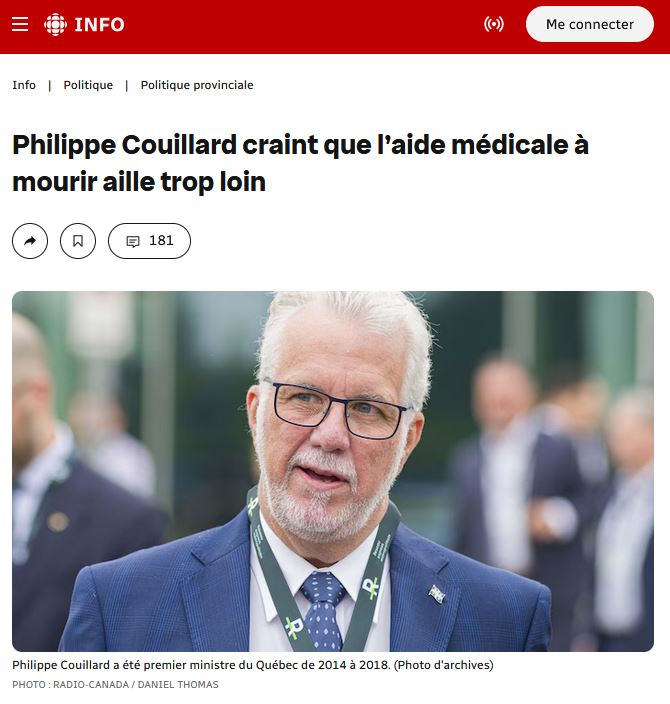
“I’m not sure that I would have again voted for that law with the
extension that we have seen in the recent years.”
This is one of
the quotes from an exceptional interview with Philippe Couillard by Catherine
Cullen on CBC’s The House, which was featured by Radio-Canada’s newsroom: https://www.cbc.ca/news/politics/phillipe-couillard-worries-about-maid-legalization-9.7376452.
He had already expressed some reservations in Alain Gravel and Alexandre Sheldon’s Ohdio podcast series in French, La mort libre (Free Death), in Episode 3, at 37:14:
https://ici.radio-canada.ca/ohdio/balados/13770/dans-loeil-dalain-gravel/1264825/loi-politique-gouvernement-legislation . But this time, he goes much further.
Listen to the full interview in English on CBC’s The House (8 minutes long, starting at 9:30): https://www.cbc.ca/listen/live-radio/1-64-the-house/clip/16242394-fears-patchwork-rules-around-advance-requests-maid
Is the Best Possible Palliative Care Accessible in Quebec?
We invite you to watch 𝐔𝐧𝐭𝐢𝐥 𝐭𝐡𝐞 𝐥𝐚𝐬𝐭 𝐥𝐢𝐠𝐡𝐭: a beautiful video that helps us understand the life stories behind palliative care. Available in both French and English (32 minutes), it can now be viewed here:
https://youtu.be/mSuPCtSk2xk?si=L5bg71FOlMui19Oa
This is an outstanding production that would, yes, have benefited from a more balanced distribution of speaking time, which would have provided a better understanding of the interdisciplinary nature of palliative care.
Congratulations to filmmaker Julien Lombard and Santé Québec West-Central Montreal Health and Social Services University Network (formerly CIUSSS West-Central Montreal) on this production, which is well worth watching!
Unfortunately, this kind of optimal palliative care is not accessible everywhere in Quebec. That is why it is also important to read this article published in Policy Options by Anne-Marie Savard, Ariane Plaisance and Alysse Gaudreault-Beaulieu:
https://policyoptions.irpp.org/fr/2026/10/soins-palliatifs-au-quebec
On this subject, the authors write:
“We still do not know precisely how many people have access to palliative care, who receives it, who is denied access, and what inequalities persist.”
The article explores possible courses of action, as does the Quebec Coalition for Access to Palliative Care, which put forward proposals during the recent election campaign.
New Series: Angles morts (Blind Spots)
You may have seen the segment on Tout le monde en parle entitled “Angles morts, a dark comedy about medical assistance in dying,” which aired on September 27. A longer version of the title might have been “A dark comedy with medical assistance in dying as its starting point.” In fact, this Quebec comedy available on ICI TOU.TV EXTRA has very little to say about MAiD, focusing instead on the misadventures of a group of friends caught up in Montreal’s criminal underworld.
Here is Radio-Canada’s synopsis (in French). MAiD is discussed primarily in the first episode, where it serves as the starting point for the storyline.
The series raises several questions about the practice. For example:
- How MAiD providers can be affected by carrying out the life-ending procedure.
- How the health-care system seeks to provide a dignified death, but often brings it about too quickly.
- How an intentionally caused death can cut years off a person’s life.
- How people face a lack of genuine choices at the end of life because of difficulties accessing health care and support services.
Guy A. Lepage quoted one of the series’ writers, Jacques Davidts, as asking: “Why isn’t there medical assistance in living, and long-term palliative care centres?”
This kind of long-term “medical assistance in living” (MAiL) already exists in several forms, including early palliative care. This brings to mind an article by Dr. Geneviève Dechêne, published in 2018 and still highly relevant today: “Early Palliative Care for All Conditions: An Urgent Need.” (in French) :
Community Forums on Medical Assistance in Dying (MAiD) — Every Opinion Counts
As part of the work of the Interdisciplinary Research Consortium on Medical Assistance in Dying (CIRAMM), community forums in French will be held in six regions of Quebec. The research team aims to gain a better understanding of the reasons behind the popularity of MAiD in Quebec.
Here are the dates:
- Bas-Saint-Laurent: December 10, 2026, from 6:00 to 8:00 p.m.
- Capitale-Nationale: November 25, 2026, from 6:00 to 8:00 p.m.
- Côte-Nord: November 10, 2026, from 6:00 to 8:00 p.m.
- Lanaudière: December 1, 2026, from 6:00 to 8:00 p.m.
- Mauricie–Centre-du-Québec: December 3, 2026, from 6:00 to 8:00 p.m.
- Montreal: November 4, 2026, from 6:00 to 8:00 p.m.
To register: https://limesurvey.umontreal.ca/882162
Please remember to click “Suivant” at the bottom of the page.
In the Media
We Implemented Canada’s Assisted Dying Law. We’re Concerned.
An open letter by Gary Rodin and Madeline Li,
published in The New York Times on October 5 (paywall).
“Dying with dignity is the only cause I believe in, socially.” – Canadian filmmaker Denys Arcand
“Some people are tired of living, past 75. If they want to go, we should let them go.”, Journal de Québec and Journal de Montréal, this morning
Full segment from Sophie Durocher’s
show Dans le blanc des yeux, starting at 12:06
In our view, these remarks must be strongly denounced, as they directly contradict suicide prevention among older adults. Worth a careful reread: this initiative by the Association québécoise de prévention du suicide (AQPS), Suicide Prevention Among Seniors in Québec: Understanding, Drawing Inspiration, and Taking Action.
Update: Sophie Durocher’s column (in French) cites our response.
https://www.journaldemontreal.com/2026/10/18/denys-arcand-lanche-un-pave-dans-la-mare
Et jusqu’à la fin la beauté: Louis-José Houde’s
show inspired by his mother’s Alzheimer’s disease
The popular comedian made a notable appearance on Tout le
monde en parle to discuss in French about his new show, whose title is so moving (“And Until the End, Beauty”). During the interview on TLMEP, the subject of advance requests for medical assistance in dying (MAID) is raised at 12:34 in the segment.
He is not opposed to the practice, which did not apply to his mother, but he aptly sums up one of the key issues: What should be done when the clinical manifestations identified in an advance request for MAID are present, but the person is still happy?
The law requires an assessment of suffering at the time an advance request for MAID is activated. Unfortunately, however, some MAID providers claim that suffering is inherent to severe neurocognitive disorders.
Response to the Upcoming Federal Bill
(MAiD for mental disorders and advance requests)
Our October 7 press release led to two interviews:
- Canadian Affairs
- Les Verbomoteurs
(in French)
Other Commentary
- “Why Canada Was Right to Ban MAID for Mental Illness” — by Professor Trudo Lemmens, Toronto Star (paywall).
- “Ottawa Keeps Mucking Up MAID” — by Dr. Ramona Coelho,
National Post.
Until Death Brings Them Together
“Turning to medical assistance in
dying as a couple”
by Jacinthe Lafrance, Le Nouvelliste (in French)
Quebec, the World Leader in Medical Assistance in Dying: Why?
A column by Dr. Benoit Heppell, Coop de l’info (in French)
Brigitte Stegemann’s Account of Medical Assistance in Dying
Since this story has circulated widely on social media, we are sharing the original account by Brigitte Frances Kranendonk, published on July 21.
The account raises numerous concerns, including the deeply troubling question of whether her grandmother’s final consent was valid.
We thank Brigitte Frances Kranendonk and her family for filing complaints with the relevant authorities, including the Office of the Chief Coroner for Ontario and the Belleville Police, which has opened an investigation.
Excerpt from the conclusion of Ms. Kranendonk’s post:
We hope her story serves as a warning and an urgent call for greater clinical transparency, mandatory family inclusion for cognitively vulnerable patients, and strict legal accountability for facilities that operate outside the law.
OCT
2026