
The Right to Die with Dignity and to Receive MAiD
What About Palliative Care?
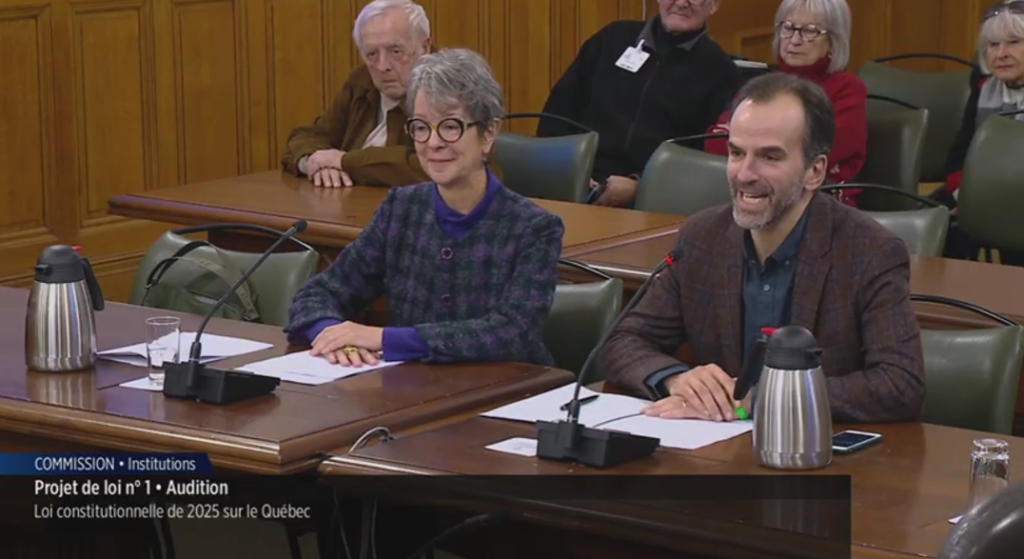
Montreal, December 17, 2025 – Last Friday at the National Assembly of Québec, Living with Dignity took part in the public hearings of the Committee on Institutions examining Bill 1, An Act respecting the Constitution of Québec, 2025. Represented by its coordinator, Jasmin Lemieux-Lefebvre, and by Madeleine Varkay, a member of its Board of Directors, the citizen network denounced the proposal to entrench in a constitution “the protection of the right to die with dignity and to receive medical assistance in dying (MAID).”
The two representatives presented the content of the brief End
of Life, Health Care and Dignity, recalling the following points:
– Living with Dignity has always opposed equating “dying with dignity” with “medical assistance in dying,” remaining faithful to the original vision of palliative care (relieving suffering through a multidisciplinary approach, without hastening or postponing death);
– its incomprehension regarding the proposal to insert a reference to the Act respecting end-of-life care under section 39 of the Québec Charter of Human Rights and Freedoms;
– end-of-life issues and concepts akin to “end-of-life care” (a term unique to Québec) do not appear in the constitutions of any member countries of the United Nations;
– the Act respecting end-of-life care, which has been amended over the years, is expected to undergo further changes in the coming years. A constantly evolving law has no place in a constitution;
– if the notion of care is to be retained in the bill, it should not be limited to end-of-life care, but should include all health care services (as is the case in other countries such as Brazil, Mexico and Finland);
– the Government of Québec is not respecting the spirit of the Act respecting end-of-life care in its communications in recent weeks regarding the constitutional project. It obscures palliative care and palliative sedation by speaking only of the right to medical assistance in dying. Yet when the Act came into force ten years ago, on December 10, 2015, legislators promised to
make palliative care “the priority.”
Ms. Madeleine Varkay concluded Living with Dignity’s testimony by recalling her extensive experience as a family caregiver (eight years) to her mother, who passed away last May. This concrete account highlighted the lack of communication and the difficulties in accessing adequate palliative care in Québec. During the exchange period with Members of the National Assembly, she also noted that medical assistance in dying had been proposed to them on several occasions.
The presentation concluded with a remark on dignity—a powerful term that unfortunately does not appear anywhere in the bill:
“We encourage you to ensure that the final version of the bill includes and uses the word dignity in a way other than to evoke the concept of dying with dignity. The constitution of a young nation like Québec should, in our view, reflect our collective desire to LIVE with dignity.”
The 21-minute hearing is available on the website of the National Assembly of Québec or on YouTube (to take advantage of translation tools).
Awareness Campaign – 10 Years After the Coming into Force of the Act Respecting End-of-Life Care
Ahead
of this public hearing, Living with Dignity launched a French-language
awareness campaign focusing on the imbalances created by Quebec’s Act
respecting end-of-life care.
The
campaign was built around the following theme:

The Revolution of the Act Respecting End-of-Life Care
10 Years Later: Imbalances
From December 1st
to 10th, a new imbalance was presented each day in a short video shared across
all social media platforms of the Living with Dignity citizen network (Facebook, LinkedIn, X & Bluesky). The
public was invited to explore each of the identified imbalances in greater
depth on the page vivredignite.org/10ans-desequilibres.
On December 10th,
our coordinator, Jasmin Lemieux-Lefebvre, gave
an interview to host Mario Dumont on QUB Radio / 99.5 FM Montréal,
which was later picked up by the QMI Agency under the headline:
Medical Assistance in Dying: Worrisome “Imbalances” in
the System
A
YouTube version is available to take advantage of translation tools.
According to the citizen network, the following are 10
of the imbalances created by the Act:
- Medical
assistance in dying: the “care” that is no longer the exception as
promised
- A
promise to prioritize palliative care, yet ongoing difficulty in measuring
access and quality
- Expanded
access to MAID: where will the slippery slope end?
- The
“right to die with dignity” becoming synonymous with MAiD
- Mental
disorders and advance requests: the ups and downs of coexistence with
Canadian law
- Advance
medical directives: an almost non-existent impact
- Continuous
palliative sedation: an end-of-life care option that remains poorly
understood
- Media
and culture: uneven coverage of end-of-life care
- Grants
and charitable status: organizations treated differently depending on
their position on MAiD
- Subtle
pressures toward an idealized premature death
Two examples of information available in French on the thematic
page that received very little media coverage:
– In 2024, 62% (!) of MAID cases administered to
individuals whose natural death was not “reasonably foreseeable” (known as
“Track 2”) originated in Quebec (data from the Medical Assistance in Dying
in Canada report published on November 28, Table C.3);
– In its most recent report, the Commission on
End-of-Life Care refused to share the palliative care data it possessed,
stating that they “are not representative of the real situation.”
The citizen network hopes that this campaign will help
reassess the legacy and evolution of the Act Respecting End-of-Life Care, ten
years after its coming into force.
– 30 –
To discuss the draft constitution and reflect on the
many issues surrounding the 10th anniversary of the Act Respecting End-of-Life
Care:
Jasmin Lemieux-Lefebvre
Coordinator
Living with Dignity citizen network
vivredignite.org/en / info@vivredignite.org
DEC
2025