
Two concrete ways to block this controversial expansion
Montreal, March
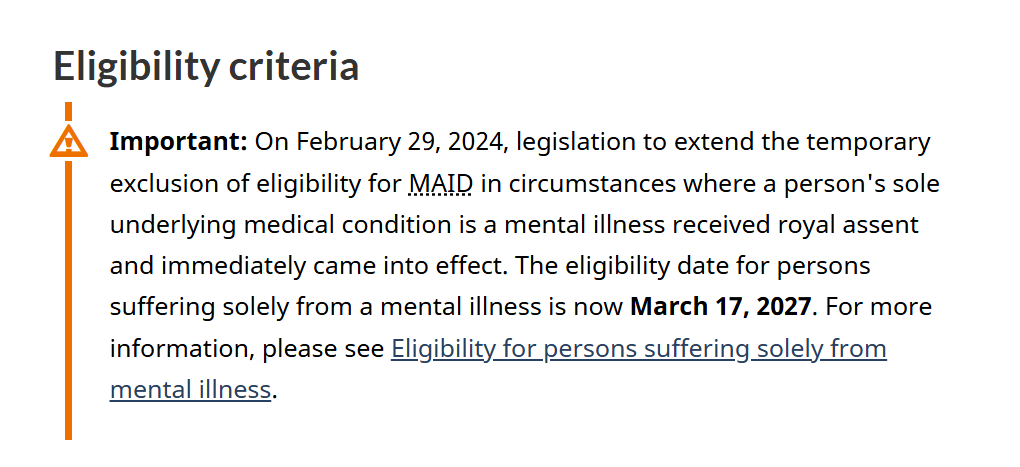
16, 2026 – If nothing is done before March 17th, 2027, that
date will mark the moment when persons whose mental illness is their sole underlying
medical condition will be able to access Medical Assistance in Dying (MAiD) in
Canada. These individuals would still have to meet the other legal
criteria, but no additional safeguards are currently planned. The Living with
Dignity citizen network hopes that federal parliamentarians will join the clear
consensus established in Quebec, which maintains the exclusion of mental
disorders in its law (Article
26).
Two concrete avenues are emerging to block this
expansion:
Bill C-218
This private
member’s bill (introduced on a non-partisan basis by Conservative MP Tamara
Jansen) seeks to amend the Criminal Code to specify that “a mental disorder is
not a grievous and irremediable medical condition for which a person could
receive medical assistance in dying.”
During the last
similar attempt (Bill
C-314) in 2023, the vote was close: 150 to 167. All members of the
Conservative Party, the New Democratic Party, and the Green Party supported it,
along with eight Liberal MPs. Surprisingly, the Bloc Québécois opposed it,
positioning itself against the Quebec consensus and the Act Respecting
End-of-Life Care.
Bill C-218 is
currently making its way through the House of Commons and remains the most
reliable way to block the end of the exclusion for mental illness.
Special Joint Committee on Medical Assistance in Dying (AMAD)
This committee, composed of
10 Members of Parliament and five senators, has been formed for a third time.
After its first meeting last Tuesday, it must now review eligibility and assess
the country’s readiness for access to MAiD when a person’s sole underlying
medical condition is a mental illness.
In 2024, it was
this committee that recommended postponing the removal of the MAiD exclusion
for mental illness.
The
reasons cited at the time were numerous, including:
- The
issue of irremediability: “…difficult, if not impossible, to
accurately predict the long-term prognosis of a person with
a mental disorder”. - The
difficulty of distinguishing such MAiD requests from suicidality.
- The
lack of professional consensus.
- The
impact on protecting vulnerable persons.
Since these
reasons remain just as relevant in 2026 and in the years to come, the Living
with Dignity citizen network hopes that Bill C-218 and the work of the AMAD
committee will lead to the permanent rejection of this highly controversial
expansion of MAiD access in Canada.
Such a decision
would also follow an
important recommendation from the latest report on Canada prepared by the
United Nations Committee on the Rights of Persons with Disabilities, which
calls on Canada to “repeal Track 2 Medical Assistance in Dying (MAiD),
including the 2027 commencement of Track 2 MAiD for persons whose “sole
underlying medical condition is a mental illness”.
— 30 —
For interviews or further information:
Jasmin Lemieux-Lefebvre
Coordinator
Living with Dignity citizen network
info@vivredignite.org
MAR
2026