
An English translation of this superb open letter, published in La Presse on July 8, 2026.
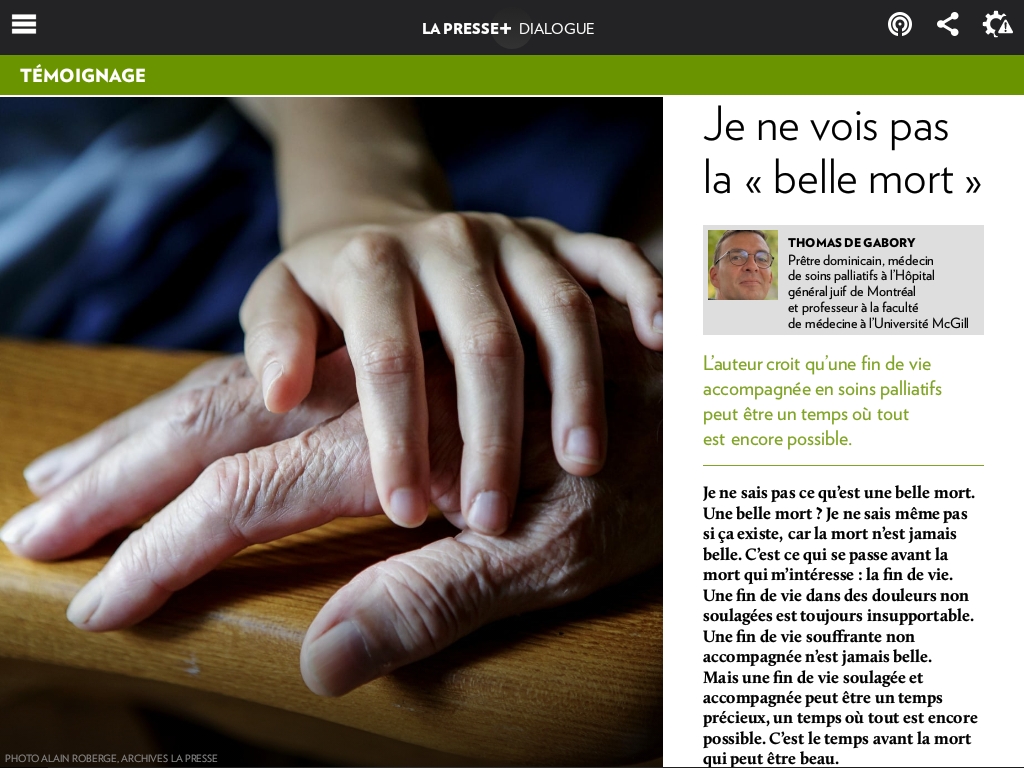
“Palliative care also means accompanying patients and their families so that every end of life is a time open to possibility: realistic hopes that give meaning, trust, and friendships that create or sustain bonds of humanity,” writes the author.
The author believes an end of life accompanied by palliative care can be a time when everything is still possible.
By Thomas de Gabory, Dominican priest, palliative care physician at the Jewish General Hospital in Montreal, and professor at the Faculty of Medicine at McGill University.
I don’t know what a beautiful death is. A beautiful death? I don’t even know if it exists, because death is never beautiful. What interests me is what happens before death: the end of life. An end of life with unrelieved pain is always unbearable. An end of life filled with suffering that isn’t accompanied is never beautiful. But an end of life where suffering is relieved and accompanied can be a precious time, a time when everything is still possible. It’s the time before death that can be beautiful.
In Quebec, MAID is part of everyday life. In the 10 years since it was legalized, it has become normalized, even commonplace. Supply has created demand. At first, MAID was reserved for people at the end of life, and then, like Pandora’s box, the eligibility criteria quickly expanded: it is no longer necessary to be at the end of life, and it is now possible to make an advance request, even before Alzheimer’s disease causes an impairment of judgment.
I care for and accompany many patients who are going to die. Some of them want to die. A few ask to die. Of all my patients who have chosen MAID, not one end of life has, in my eyes, been truly peaceful.
What is shown on television or on social media is nothing but a romanticizing of induced death. The reality is quite different and doesn’t appeal to me. No one has managed to convince me that this is a beautiful death.
Patients who choose MAID are asserting control over their end of life and want to manage everything: the day and hour of their death, the place, the people present at their side, the music, the clothing, sometimes even the champagne for a final toast. I don’t judge this desire for control, and I don’t know myself how I would want to manage my own death when the time comes.
However, I notice that this control often produces an inner tension. These patients say they are at peace. Yet what I observe looks more like the satisfaction of having organized and controlled everything than genuine inner peace. Often they
have only one idea left in mind: to end things as they’ve decided. Their heart sees only one door left ajar, leading to induced death, and no longer sees other possible paths.
Another path
Palliative care offers another path. In the interdisciplinary team I’m part of, we put all of our skill and energy into relieving the pain and discomfort of people at the end of life. Contrary to a lot of misconceptions, palliative care patients are not zombies doped up on opioids, and we don’t just play guitar. There is never overzealous treatment, and we don’t prolong suffering.
No one wants to suffer or watch someone suffer. Palliative care also means accompanying patients and their families so that every end of life is a time open to possibility: realistic hopes that give meaning, trust, and friendships that create or sustain bonds of humanity.
The end of life can then become a time that allows for letting go, accepting losses, and coming to terms with the death that is approaching.
Unlike control and mastery, letting go opens up the possibility of a peaceful end of life: a time when one lays down one’s arms, loosens one’s grip, and where the inner struggle gradually eases. In this fragile calm, palliative care teams sometimes witness ends of life of great beauty.
I am a palliative care physician. In conscience and as part of a team, I want to relieve and accompany patients who tell me: “I want to die, I want to end my life, it no longer has meaning, I don’t want to be a burden to my children, I’m afraid of suffering.” To me, these are unbearable forms of suffering, sometimes expressed through a request for assistance in dying.
That is why I could never push the four syringes that cause death. Not because I want to prolong the suffering of patients who ask to die. My conviction lies elsewhere: I must not respond to a request for induced death, but to the distress being expressed through that request.
After so many relieved and accompanied ends of life, I remain convinced that one dies better through letting go than through control. That is why I place my bet on palliative care: it leaves open the door to an end of life that can still be beautiful, whereas induced death closes it.
JUL
2026