
Dear allies,
The Living with Dignity citizen network is back from summer break as the Quebec election campaign gets underway, and we’ll be following it closely for you.
Lots of information to share as we get back into the swing of things. Thank you for your support of our mission,
Jasmin Lemieux-Lefebvre
Coordinator
Living with Dignity citizen network
Breaking down the Journal de Montréal front page from August 4th
Earlier this month, the Journal de Montréal (and de Québec) ran this front-page headline:
With medical assistance in dying
Record number of organ donations
The article was accompanied by a photo of Ms. Caroline Goulet, who died on July 16th, 2026, at the age of 47.

The first article covered the end of life of
Ms. Goulet, who was pleased to be able to donate her organs to four people
following her medically assisted death. She lived with multiple sclerosis. The
second article discussed the record number of 27 Quebecers who chose last year
to donate their organs after receiving MAID. As soon as the piece was
published, we responded on our social media to point out the many ethical
questions this act raises: “When donation appears to be encouraged by
health care professionals or family members, this can create a sense of
obligation or otherwise influence the patient’s decision to proceed with MAID.
(…) Moreover, moral expectations placed on patients could discourage them
from reconsidering their decision, for fear of disappointing those around
them.” (excerpt translated from D. Rodríguez-Arias et al., “Organ Donation After Medical Aid in Dying: An
Ethical Overview,”
Bioethics 40, no. 3 (2026): 350–358).
On August 8th, Jonathan Marchand, president of
Coop ASSIST and disability rights advocate, published a piece that went on to
go viral (1,200 reactions, 337 shares on Facebook). He shared this 2024 YouTube
podcast, “Multiple Sclerosis, I’m Talking
About It with Caroline Goulet” (in French). In it, Ms. Goulet spoke about various challenges
reflecting a clear lack of day-to-day support.
We invite you to read some of the comments
(+660!) under Mr. Marchand’s post, which he took the time to respond
to thoughtfully. Chapeau!
We shared our discomfort with the journalist
over the lack of any mention of the shortage of access to care and services
leading up to Ms. Goulet’s MAID. We also suggested that Transplant Québec stop
promoting organ donation this way for people about to receive MAID. Transplant
Québec’s approach has always been not to raise the question of organ donation
before a person’s MAID request has been approved. Promoting it upstream to a
broad public may lead a person to consider a so-called “altruistic”
death rather than fight for access to the care and services they are entitled
to. This narrative echoes the “false choice” faced by people with
disabilities in Canada, denounced by Ms. Rosemary Kayess, Vice-Chair of
the UN Committee on the Rights of Persons with Disabilities. This is a real problem that needs
to be addressed.
Quebec’s proposed bill on self-directed
personal assistance is a step in the right direction: https://coopassist.ca/programme-apa/ (in French).
On our radar
The
Quebec elections
The campaign
leading up to the October 5th elections began on August 28th. We will be
speaking out publicly in the coming days to reiterate our citizen network’s
priorities. In the meantime, don’t miss the following (in French):
- Analysis
of the electoral platforms by the Confédération des organismes de
personnes handicapées du Québec (COPHAN);
- Electoral debate on mental
health organized by the Coalition communautaire en santé mentale,
on September 8th at 10 a.m., on Facebook Live or via Zoom.
- Debate
organized by the Société québécoise de la déficience intellectuelle,
on September 22th at 7 p.m., via
Zoom.
Response
to the AMAD committee report
Canada’s Minister
of Justice, Sean Fraser, must respond to the recommendation from the joint
committee report on medical assistance in dying (“That the Government of Canada amend the
Criminal Code to indefinitely exclude eligibility for medical assistance in
dying for persons whose sole underlying medical condition is a mental
illness”) by October 15th, i.e., 120 days after the committee report was
tabled.
Mental
disorder: emergency exemption to access MAID
Ms. Claire Brosseau, who has lived for 35 years with bipolar disorder and
post-traumatic stress disorder, is hoping to obtain an emergency
exemption to access MAID. Ontario’s Superior Court of Justice could rule on the matter shortly.
Blocking
MAID for mental disorder with Bill C-218
MP Tamara Jansen’s bill seeks to “amend the Criminal Code to provide that a
mental disorder is not a grave and irremediable medical condition for which a
person may receive MAID.” The next discussion on this topic in the House of Commons is
expected in early October.
To watch, read, and listen to
- Two sisters seeking home care
for their mother living with Alzheimer’s decry an ordeal imposed by the
health care system (in French)
Le Journal de Montréal, August 31th, 2026
Analysis by Nicole Poirier (Carpe Diem – Alzheimer Resource Centre) via her social media on LinkedIn and Facebook. - International comparison of
assisted dying regimes, part 2 – Safeguards surrounding requests and
assessments
Cardus Institute, August 31th, 2026 - New
issue of the Cahiers francophones de soins palliatifs now available
online (in French)
Institut de soins palliatifs et de fin de vie Michel-Sarrazin – Université Laval, August 31th, 2026 - How to take part in World
Suicide Prevention Day, September 10th ? (in French)
Association québécoise pour la prévention du suicide - France upholds assisted dying
law
AFP, August 14th, 2026
- Post from Dr. Claire Fourcade,
head of advocacy at French Society for Palliative Care and Support, on
LinkedIn (in
French):
Canada used to be a world leader in palliative care alongside the United Kingdom. It has now been downgraded to the lower tier. It is now the leading country for “aid in dying.” We can’t do everything, can we?
Source: First global ranking of palliative
care: the 2025 world map according to the new WHO framework
(Journal of Pain and Symptom Management, November 2025)
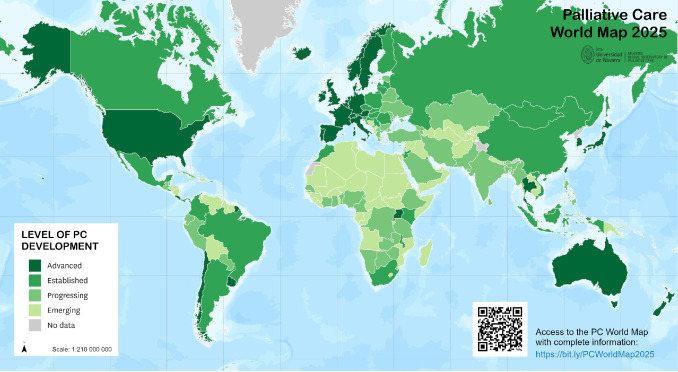
Access the interactive map here.
Canada’s ranking: second tier and 40th in the world.
SEP
2026