
A theatrical moment that has to be experienced!

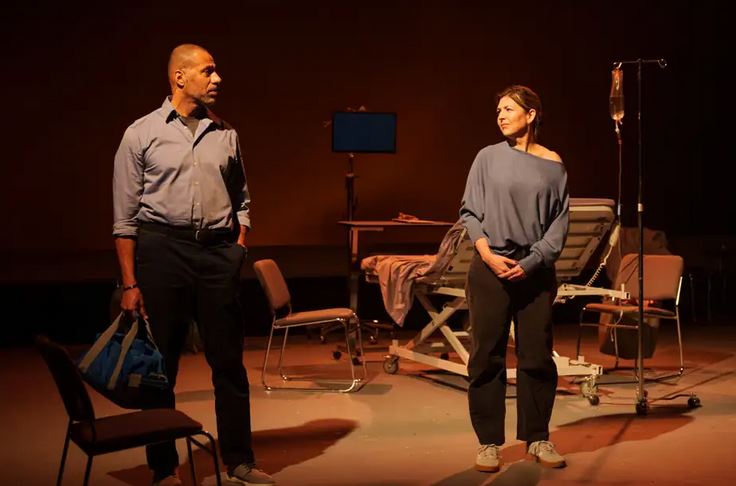
There are works you should dive into without quite knowing what you’re getting into. The new play by the documentary theatre company Porte Parole is a perfect example. The creator of Club sandwich mayonnaise, the renowned producer Manuelle Légaré, invites us to revisit the moments that led to her father’s medical assistance in dying (MAiD), the great stand-up comedian Pierre Légaré (the name of the play is inspired by one of the last jokes he made before MAiD). Through a series of flashbacks, she attempts to better understand what motivated his choice.
In her deeply emotional narrative, she also meets a wide range of witnesses to the evolution of MAiD in Quebec (the texts are drawn from interviews with real people: MAiD providers, a legal expert, anthropologists, patients, a care attendant, etc.). Manuelle observes and comments on these scenes, in which the characters are brilliantly portrayed by actors Alice Pacual, Sylvie de Morais-Nogueira, and Martin-David Peters (the author’s own performance – her stage debut – is particularly effective).
We should also highlight the creativity of director François Bernier, who surprises us throughout the performance.

 You’ll understand the emojis after seeing the play.
One of these many protagonists is our coordinator, Jasmin Lemieux-Lefebvre, who appears in a brief segment blending humor and reflection on the issues we have championed since 2010. The carefully measured humor helps carry the audience through this 1 hour and 50 minute play without intermission, as the themes explored are emotionally charged.
The inquiry conducted by Manuelle Légaré presents many positive and negative facets of MAID, along with several unresolved questions that deserve deeper exploration. A strong – and refreshing – theme of freedom of speech runs through the whole play, turning it into a genuine space for reflection. Positive experiences are acknowledged without silencing critical perspectives. As Philippe Couture notes in the theatre review JEU (in French), there is no doubt that Club sandwich mayonnaise dares to “crack the consensus.”
By delving into the rapid MAID process experienced by Pierre Légaré and his loved ones (less than 48 hours), the play offers the advantage of a very concrete narrative, but also the drawback of anecdote, since it reflects a single family’s experience. Fortunately, the range of experiences presented by other characters – though more briefly – provides a broader view of the issues surrounding MAID. As for palliative care, its specific challenges are thoughtfully addressed as a distinct theme in the play.
In summary, we strongly recommend seeing this production. You will appreciate the quality of the documentary research, the emotional range, and Manuelle Légaré’s passionate search for ways to improve end-of-life care in Quebec. Before attending, don’t forget to respond to the Université de Montréal researchers who are studying the impact of the play Club sandwich mayonnaise.
Additional reflections
In 1 hour and 50 minutes, it’s impossible to cover everything. Here are a few elements that could have further enriched the play (constructive suggestions in response to the dialogue it sparks):
1) Exploring the impact of palliative care
Its contributions and benefits are only briefly addressed, as more emphasis was spent on its invisibility and limited accessibility. Testimony highlighting the richness of care in a would have helped better comprehend this often.
2) Valuing life immediately before death
The end of life can be a time of profound human connection. It may be tempting to bypass this period as futile, yet there is so much to experience at a moment when the value of existence can seem to fade.
3) Seeking meaning at the end of life
While rituals are mentioned, the play often presents the end of life as devoid of meaning. This contrasts with our experience in the field, where the final stage of life often prompts deep reflection on the purpose of existence and one’s own life. Let’s not forget that spiritual care (religious or not) is an integral part of the palliative approach.
End-of-life conversations can lead to reconciliation, confidences, and liberating words— for both the person who is dying and those who remain – giving them a reinvigorated relationship.
4) The importance of volunteers in end-of-life care
Volunteers often play a key role in helping individuals through their final stage of personal growth. Through attentive listening, they help patients articulate their experiences, questions, and evolving perspectives on life and relationships. Interactions with volunteers can sometimes be broader and deeper than certain family interactions, precisely because they are more neutral. Volunteers help restore warmth and humanity, encouraging individuals to fully engage with themselves and their relationships. palliative care home or other settings misunderstood environment
APR
2026