
“The narrative that MAiD provides a peaceful, beautiful death every time is false. (…) Informed consent requires disclosure of complications and adverse outcomes, not just promises of a beautiful death.”
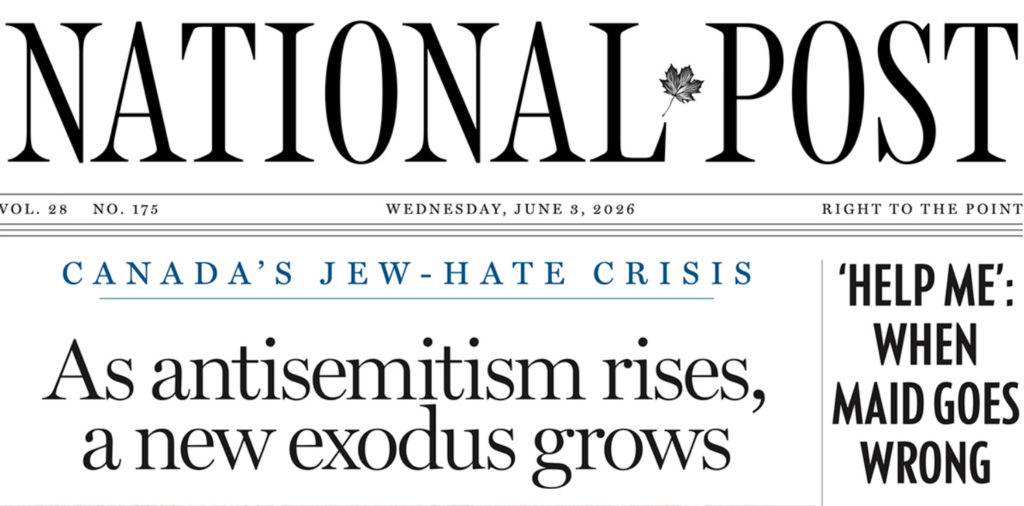
We support this response by Dr. Ramona Coelho to the front-page National Post article of June 3, 2026 (available on her X account).
Below is an excerpt of the report published under the title “Help me”: When MAiD Goes Wrong.
The article recounts a medical error and a complication that occurred during the administration of medical assistance in dying (MAiD). These examples challenge the narrative that MAiD is always synonymous with a peaceful death, as do the
following two studies cited by journalist Sharon Kirkey:
1) Medications and dosages used in medical assistance in dying: a cross-sectional study (2022)
https://www.cmajopen.ca/index.php/content/10/1/E19
Excerpt:
“There were 41 complications reported (1.2% of cases), most of which fell into 1 of 2 main categories: problems obtaining intravenous access or loss of intravenous access after the MAiD procedure was started (23 cases), and prolonged time to death, necessitating a second kit (16 cases). The reasons for use of a second kit (e.g., intravenous access failure, drug underdosing, accidental wastage or breakage of medication) were not reported. .”
2) Narratives of Dignity in Complex MAiD Bereavement Stories (2025)
https://muse.jhu.edu/article/979952
Excerpt:
“The analysis identified three dignity narratives in participants’ stories: the Dignified MAiD Narrative, the Traumatic MAiD Narrative, and the Unjust MAiD Narrative. … (The latter two) provide counter perspectives that challenge the notion that MAiD unequivocally leaves a legacy of a dignified, good death.”
Should informed consent not include disclosure of expected outcomes, including specific risks and potential complications?
“HELP ME”: WHEN MAID GOES WRONG
Full text: https://nationalpost.com/news/maid-complications-assisted-suicide
Doctor administered death is portrayed as a rapid, peaceful and comfortable death, yet potential complications are a recognized risk that some experts worry are not being fully discussed with people as a routine part of obtaining informed consent.
The possibility of “failed MAID” was highlighted last week in media reports of the 2024 death of Bradley Stewart, an Ontario man who resumed breathing after being pronounced dead by a London, Ont., family doctor and MAID provider — a traumatic experience his siblings who witnessed his mishandled death are still recovering from.
The doctor, James Maclean, didn’t administer the customary sequence of drugs, and left before Stewart resumed breathing.
The case has raised questions about what happens when medical assistance in dying doesn’t proceed as planned.
No medical procedure has zero risk of complications or unexpected outcomes, said Dr. Ramona Coelho, a family physician and former member of the Office of the Chief Coroner of Ontario’s MAID death review committee. “Yet some MAID clinicians publicly portray MAID deaths as uniformly peaceful, beautiful and free of complications.”
“This does not present an accurate picture of reality and risks influencing decisions about MAID” based on an idealized portrayal of assisted death, Coelho said.
Another case reviewed by the Ontario coroner’s office and obtained by National Post describes the death of “Mr. D.,” an anonymous 87-year old man with congestive heart failure who uttered “help me” while undergoing MAID in 2023.
Two assessors agreed that Mr. D met all eligibility for MAID, that it was a voluntary request and that he was suffering a grievous and irremediable medical condition.
The doctor administered the first drug, midazolam, a Valium-like sedative. Next lidocaine was injected to numb the vein and prepare it for the next injection, propofol, a coma-inducing drug that can burn and sting upon injection.
Midazolam is meant to put people in a deep state of relaxation. People often fall asleep.
However, “During the first three minutes. Mr. D experienced signs of physical and psychological distress, including groaning, guarding (tensing muscles) and grimacing,” reads the case review.
“Mr. D did not experience expected sedation” from the midazolam. Instead, he remained conscious.
(…)
In a survey of 335 Canadian emergency doctors, three reported having seen MAID patients come to emergency because of IV failure.
A 2022 study of 3,557 MAID deaths in Ontario and Vancouver between 2016 and 2020 found complications in 41 cases (1.2 per cent). Most fell into one of two categories, the authors reported: obtaining or maintaining IV access, or prolonged time to death requiring a second kit of MAID medications.
Overall, death occurred within three to 15 minutes in most cases. The shortest documented time to death after the first injection was one minute; the longest, 127 minutes.
Another small study involving five family members who had complex MAID bereavement experiences found that while some witnessed a peaceful death, other accounts challenged the narrative “that MAID unequivocally leaves a legacy of a dignified, good death.”
(…)
JUN
2026