
Our Living with Dignity Newsletter
Dear allies,
As Québec enters the annual construction holiday, we wanted to send you a brief newsletter with a few updates. The issues we work on do not take a summer break.
Thank you for your continued support throughout the summer.
Jasmin Lemieux-Lefebvre
Coordinator
Living with Dignity Citizen Network
France Adopts an “Assisted Dying” Law
On July 15th,
French lawmakers adopted legislation establishing a right to “assisted dying”
(assisted suicide and euthanasia).
We wish to
reaffirm our solidarity with all those who have defended the vision of
palliative care as the relief of physical, psychological, social, and
spiritual/existential suffering—without ever intentionally causing death. Their
work continues, as does ours.
Three
observations:
1) Media
coverage in Québec relied primarily on reports from the Associated
Press and Agence
France-Presse. In both cases, the principal critical perspective came from
the organization Alliance VITA, whose spokesperson, Tugdual Derville, stated:
“every
effort must be made to ensure that people who are suffering have immediate
access to palliative care and support. Presenting death as a desirable solution
can never be an acceptable response to suffering and is contrary to human
dignity.”
2) France
will establish both an Observatory on Assisted Dying and an Ethics Reflection
Forum on Assisted Dying. We commend the co-founders of the Collectif
Démocratie, Éthique et Solidarités, Emmanuel Hirsch and Laurent Frémont, for
this initiative.
3) We
strongly recommend the YouTube video “Aide à mourir : ce que le texte propose
vraiment” (“Assisted Dying: What the Bill Really Proposes”),
published in French on the Za channel, which features critical
psychology content.
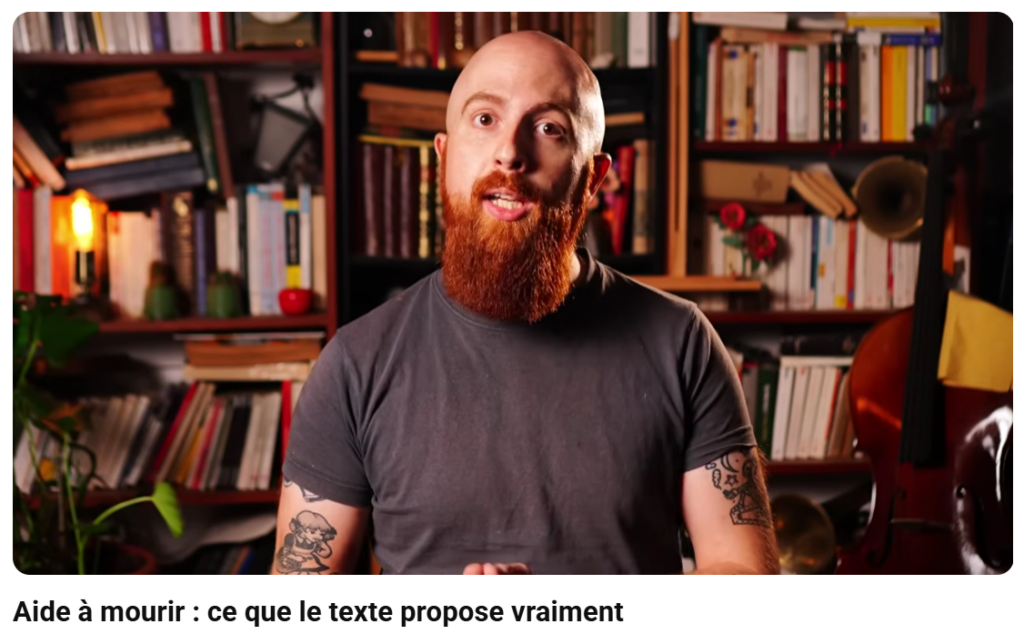
The first
part of the video offers a compelling response to a French MP’s argument in
support of the bill, in which he quotes Victor Hugo (“To die is nothing;
not to live is dreadful”).
The second
part presents a thoughtful overview of the arguments advanced by the
anti-ableist movement (known in France as the anti-validist movement) in
opposition to euthanasia, assisted suicide, and assisted dying.
Active Lobbying in Support of MAID for Mental Illness
The
recommendation of the federal AMAD committee not to proceed with expanding MAID
to people whose sole underlying medical condition is a mental illness continues
to generate debate.
Two open
letters published last weekend remind us that advocacy efforts are underway to
influence the federal government’s response, which Justice Minister Sean Fraser
is expected to deliver following consultations during the summer (no timeline
has been announced).
1) MAID
and Mental Illness: We Must Trust Health Professionals and the Patients
Concerned (published in French in Le Devoir), signed by Laurent
Boisvert, Mona Gupta, and Valérie Fernandez, respectively:
- President of the Québec
Association for the Right to Die with Dignity;
- Psychiatrist and researcher at
the CHUM, former chair of the Expert Panel on MAID and Mental Illness;
- President of the Québec Order
of Social Workers and Marriage and Family Therapists.
2) Mental
Illness: Offering Medical Assistance in Dying to Prevent Suicide
(published in French in Le Soleil), signed by Dr. Chantal Descoteaux and
Dr. Claude Gagnon, both former coroner’s investigating physicians in the
Saguenay region and MAID practitioners.
The first
letter advances familiar arguments. The second presents a particularly
troubling perspective.
In
response, we recall the words of psychiatrist John Maher, from his testimony
before the AMAD committee:
“The idea
that assisted suicide is preferable to a tragic death completely misses the
point. What is preferable is treatment aimed at preventing a tragic death as
well as medical assistance in dying.”
We also
support the July 3rd open letter published in Le Soleil by Georgia
Vrakas, Ph.D., psychologist and Associate Professor in the Department of
Psychoeducation and Social Work at the Université du Québec à Trois-Rivières:
“Medical
Assistance in Dying for Mental Illness: Is the Debate Over?”
Please do
not hesitate to contribute to the public conversation on this issue throughout
the summer.
Reflections on the Film "125, rue des Malaises"
The Québec dramatic comedy 125, rue des
Malaises, released in theatres on July 16th, addresses the topic of
medical assistance in dying, but we will not be reviewing the film.
The subject is presented in a fictional setting
in which MAID is available to people who are not ill. It serves primarily as a
narrative device to explore family relationships—sometimes difficult, sometimes
moving.
In a radio interview on Montréal 98.5FM (at
6:30), actor Rémy Girard described his character as follows:
“The absurdity is that he isn’t sick (…), yet
he’s convinced he’s going to request MAID (…). That’s where the comedy comes
from.”
Unfortunately, in the Québec context, MAID for
“tiredness of life” remains among the “cases requiring further study,”
according to the Collège des médecins du Québec, which has yet to adopt a
formal position on the issue (see
its 2021 discussion paper).
Revue de presse
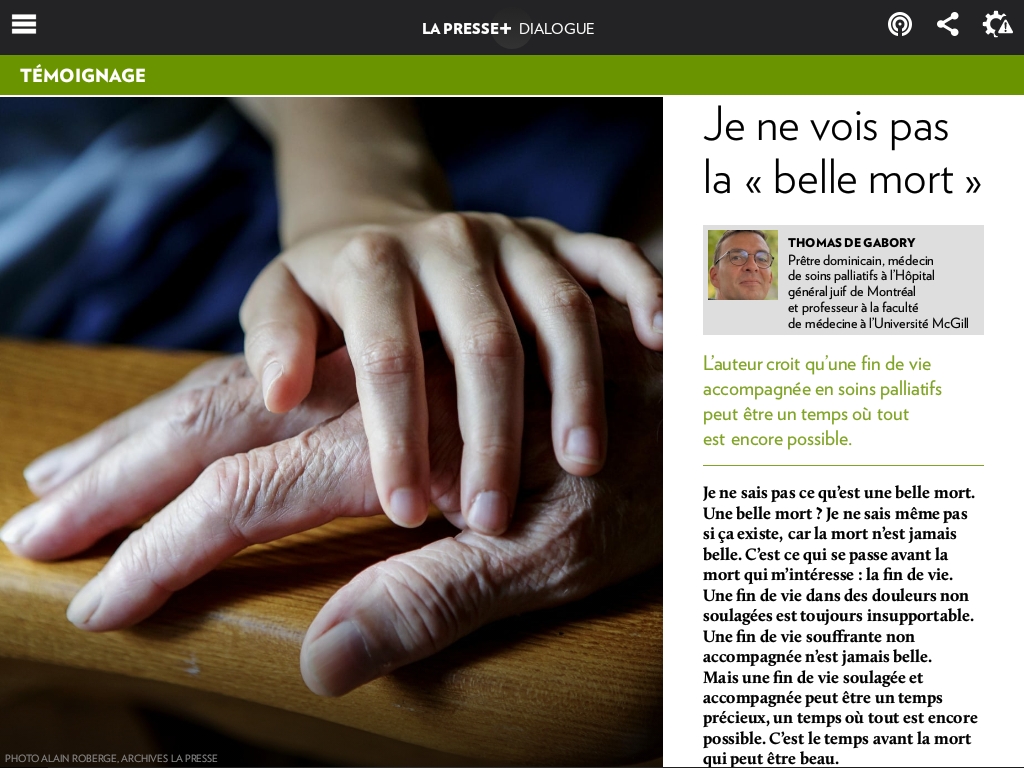
– Medical Assistance in Dying – I Do Not See the ‘Beautiful Death’ (La Presse)
An outstanding letter – by Thomas de Gabory, a Dominican priest working in palliative care at the Jewish General Hospital in Montréal and a professor in McGill University’s Faculty of Medicine.
Here is an English translation on our website.
We especially appreciated La Presse‘s introduction:
“The author believes that a life accompanied through palliative care can remain a time when everything is still possible.”
We also appreciated the readers’ responses published by La Presse, particularly those of Céline Roy and Geneviève Thibault, whose perspectives we share.
– Disability and MAiD
A Discussion Paper of Public Opinion Polling (available
in French since July 29th) by Cardus.
– My Friend Does Not Have to Die
“She told me she has been approved for MAID. I have been struggling to understand what Canadians are being asked to accept.” A moving letter by Tricia Toso, published in the Montreal Gazette.
– It’s time for Parliament to legislate proper MAiD oversight
Dr. Ramona Coelho, in National Newswatch.
– Beware the Idealized Portrayal of the Law Legalizing Medical Assistance in Dying
Our open letter, published on the editorial page of Le Devoir.
Here is an English translation on our website.
JUL
2026